Streets Ahead
Our Streets Ahead Campaign is focused on making streets and outdoor public places more accessible for people living with a visual impairment. The campaign encompasses three main areas: Shared Surfaces, Pavement Parking and Street Clutter.
On this page
Pavement Parking
When cars are parked on pavements, people with a vision impairment may have to risk their lives by walking into the road just to get by them. This is an issue that also impacts parents with prams, wheelchair users, older people and many others.
Pavement parking is consistently highlighted as one of the key challenges people with sight loss face; 81% of people with sight loss said that reducing obstacles on pavements and street clutter was important to improving their quality of life.
Our research has also found that four out of five blind or partially sighted people said that pavement parking makes it difficult to walk on the pavement at least once a week.
YouGov polling of councillors commissioned by Guide Dogs in September 2023, 74% of councillors in England supported a national law. It is clear change needs to happen.
A standardised law across the country would make it clear that pavement parking should be the exception, not the norm for motorists, and give local authorities real power to properly tackle this problem. We want a clear law where drivers cannot park on the pavement unless in a specifically designated area, in line with Greater London and Scotland.
Receive updates on any number of our campaigns and discover what you can do to help
Blocked In: The Impact of Pavement Parking
Designing for Inclusion
The accessibility challenges of some active travel infrastructure for people with vision impairment and other disabled people.
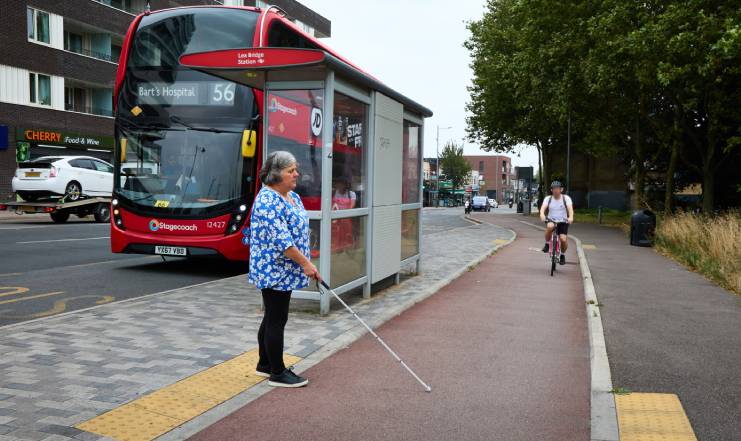
No one should feel unsafe when they walk or use public transport in the streets and spaces where they live or work. Yet we increasingly hear that street designs are creating barriers for disabled people. That is why Guide Dogs commissioned University College London (UCL) to explore the impact of four different types of design on disabled people, including blind people and people with a vision impairment. We looked at Floating Island Bus Stops, Shared Bus Stop Boarders, Segregated Cycle-footways and Continuous Footways. These designs all incorporate cycle paths into their design, although some elements of these designs are used in other streetscapes.
All I want to do is feel safe when I’m going out. It’s not much to ask is it?
Based on the findings of the UCL research, Guide Dogs have developed recommendations that we will be sharing with governments across the UK and local authorities.
Listen to the Design for Inclusion webinar
Shared Surfaces
Shared surface streets (sometimes called a level surface) are where the road and pavement are built at the same level, removing the kerb so that cars, buses, cyclists and pedestrians share the same surface. In some cases, controlled crossings (pelican crossings) are also removed.
Shared surface streets are dangerous for people with a vision impairment, who rely upon the presence of the kerb to know they are on the pavement and not in the road.
The shared surface concept is intended to be a way to provide:
- an attractive street environment with slower traffic
- less street clutter
- a people friendly space
Guide Dogs has been campaigning against the use of shared surface streets as part of our Streets Ahead campaign, supported by organisations representing disabled people across the disability sector, older people and other groups.
Key concerns for people living with sight loss:
- You have to make eye contact
Pedestrians, motorists and cyclists have to make eye contact to decide who moves first. This obviously compromises the safety, independence and confidence of people living with a vision impairment. - People rely on the kerb
People with a vision impairment, particularly guide dog owners and long cane users, use the kerb as a navigation tool to know where they are in a street.
As a result, many people with sight loss, disabled and elderly people have said that they feel unable to use the shared surface street in their town. People with learning difficulties, people who are deaf or hearing impaired, older people and young children can also experience difficulty with shared surface streets.
As a pedestrian I was unsure vehicles would stop, as a driver I was unsure vehicles would stop and who knew who had the right of way, and as a cyclist it's extremely intimidating.
Street Clutter
Guide Dogs research shows that 97% of people with a vision impairment have problems with street clutter, such as shop advertising signs (A-Boards) and street cafe furniture, which are littered across the pavement.
A clearer high street, where obstacles like A-boards and cafe furniture are placed consistently, leaving plenty of room for pedestrians to walk past, not only makes it a safer place for people with sight loss, but also a nicer, more inviting place for all shoppers. We are campaigning for tidier, more accessible streets.
The main road through my town centre has so many A-boards in it that it feels as though you are running a 3,000 metre hurdle race rather than walking through a town centre. Many people have complained to the council, and it has been in the local press. The council have said these boards are not licensed and they intend to take action.
Why we are campaigning
Although to some people these issues may not seem particularly bad, shared surfaces, pavement parking and street clutter all make the lives of people living with a vision impairment harder. For some it can be just another reason to stay at home. All our campaigns strive to end the isolation people with vision impairment feel and aim to make the world a more accessible place, which is why we are campaigning for cleaner, easier street navigation as part of Streets Ahead.
The time to make change is now. Are you with us?
Related content
- Open Doors
- Children and young people
- Transport
- Streets Ahead