You may wish for your child to attend pre-school or nursery before they reach school age to give them the opportunity to learn outside the home and support their development. Finding the right early years setting for your child with a vision impairment is an important first step in their education, so we've outlined some guidance to help you make the right choice.
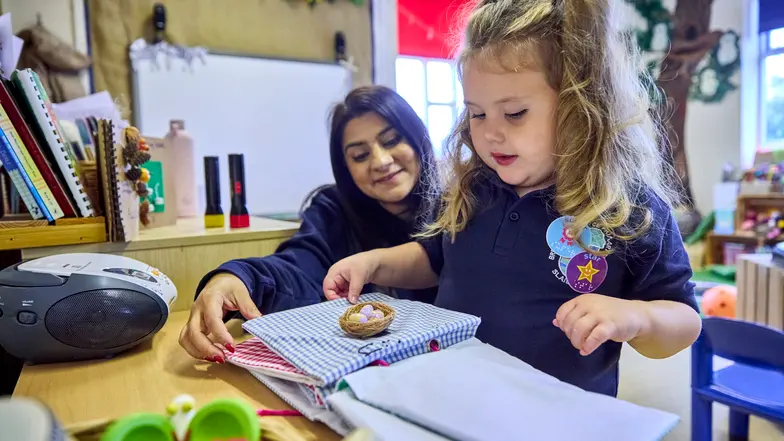
If you would like your child to attend a pre-school provision, you may be eligible to receive funding to help with the costs. There are currently three government-funded childcare schemes that offer free childcare for children living in England aged two, three, and four.
To be eligible to receive this funding you must either be in receipt of one of the following benefits:
Or have a child that falls under one of the following categories:
The earliest you can apply for the two-year-old funding is the start of the term in which your child turns two but the childcare will not start until the beginning of the term after you apply. Children in receipt of an Education, Health and Care Plan (EHCP) may be eligible for top-up funding. Take a look at more information on receiving this funding and ask for further advice from your Local Authority who will be able to provide more information.
This is available to all three and four-year-olds and there are no income-based requirements. You will be eligible to receive 570 hours per year of free childcare beginning the term after your child’s third birthday (for example, 1 January, 1 April or 1 September). This is usually taken as 15 hours a week for 38 weeks of the year but you can choose to take fewer hours over more weeks, for example.
More information on receiving this funding for 15 hours free childcare per week.
To be eligible for this level of funding for your three or four-year-old, you and any partner must expect to earn, on average, the equivalent of working 16 hours a week at the national minimum wage. Here are the full details on how to receive this funding for 30 hours free childcare.
Once you have decided on an early years setting for your child, a meeting should be arranged between you, the Special Educational Needs and Disabilities Coordinator (SENDCo) and any other key professionals working with your child, such as the Qualified Teacher of children with a Vision Impairment (QTVI), to work on a transition plan. In that meeting we recommend you consider:
Also, it's important to think about the support available after these transition sessions, for example:
The QTVI or other organisations may be able to help with this, for example:
You can help prepare your child for nursery by encouraging them to develop some self-help and independence skills at home, such as:
You can help your child get used to the change by:
We can offer you independent and impartial information, advice and guidance to help you navigate your journey through the education system.