_003.jpg?format=webp&width=3840&quality=75)
Vision has a very important role in your baby’s early years development. Children learn by copying what they see others do, they observe how people interact and watch to see how something responds to their actions. Vision also encourages mobility by providing the motivation to move towards an interesting object, and is helpful for learning new skills like finger feeding.
If your child has a vision impairment, they may need to learn and explore the world in a slightly different way. Sensory activities and learning through play can help your child gain confidence, achieve their milestones and understand the world.
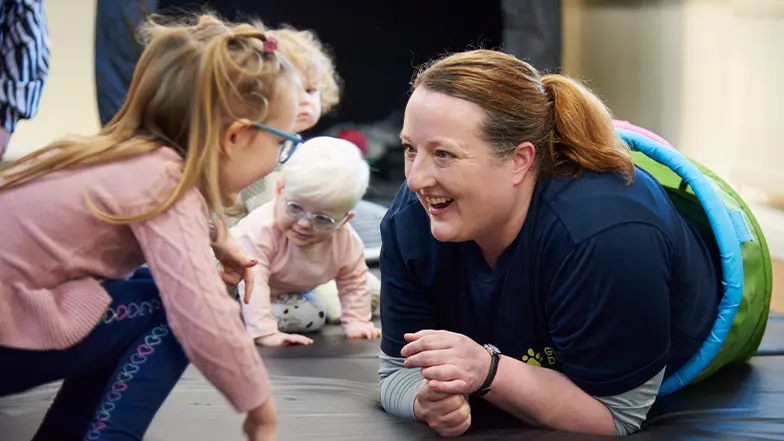
Play is fundamental to your child's development, especially in the early years. Play helps your child to develop movement, communication skills and an understanding of the world around them. It motivates children to explore and interact with objects and people, building their confidence and sense of self. Through play, children develop the practical skills they need such as: communication skills, fine and gross motor skills and language development.
_013.jpg?format=webp&width=3840&quality=75)
If you have received support from your local authority or Guide Dogs, you might have heard of habilitation. Guide Dogs’ habilitation specialists support families, carers and nurseries by encouraging everyone involved with your child to feel confident in how to provide the specific support that your child needs. Habilitation covers a wide range of skills and activities, always with your child at the centre. We provide individualised support including learning through play and sensory activities for babies, toddlers and young children. Our specialist support helps to reduce the impact of sensory impairment in children, and maximises their social inclusion by focusing on key development areas such as early movement, social and communication skills and early self-help.
We’ve developed free online resources containing information, guidance and activities, to help support your child's early years development through play.
The activities cover five key development areas and can easily be done at home, using everyday items. The five development areas are:
Concepts form many rules in routines, such as the concept of time – when we eat, sleep and play; support actions such as placing a teddy bear on a chair or a ball into a box; and spatial awareness of something being in front or behind. Concepts also help when describing things, for example their pillow being soft or the table being hard.
Your child can learn so much about the world around them using their other senses. Touch and sound can be key to helping them move around and participate in activities, so it’s crucial they feel confident exploring different textures, sounds and smells. Senses also play a key part in understanding movement – whether walking fast or slow, bending, stretching or off-balance.
To become a confident little mover and explorer, your child needs to develop a broad range of movements and skills. From rolling, sitting and crawling to walking, or reaching out to grasp their favourite teddy, using a spoon and taking a drink, or helping to put their clothes on. Many of these early movement skills are visually motivated, so your child may need a little bit more help.
It doesn’t take long for your child to take their first steps towards independence, starting with holding their bottle. With a little help, this can soon develop to feeding themselves with their fingers, learning to brush their teeth and helping when you’re dressing them.
Communicating in a way that your child understands is vital, especially if they’re unable to see visual cues and information. You may need to give your child more verbal information and description during play and other activities, so they can develop their early communication and language skills.
These sheets have been created to align with the stages outlined in the Developmental Journal Babies Visual Impairment (DJVI). This is a recognised framework used by many health, education and habilitation professionals when working with children with a vision impairment up to the age of three.
The sheets are grouped into developmental stages that relate to the age of a child. These are purely for guidance; you’ll know your child best as to how their development is progressing. We’ve also added two additional stages, six and seven, to continue supporting your child's development up to 4+ years.
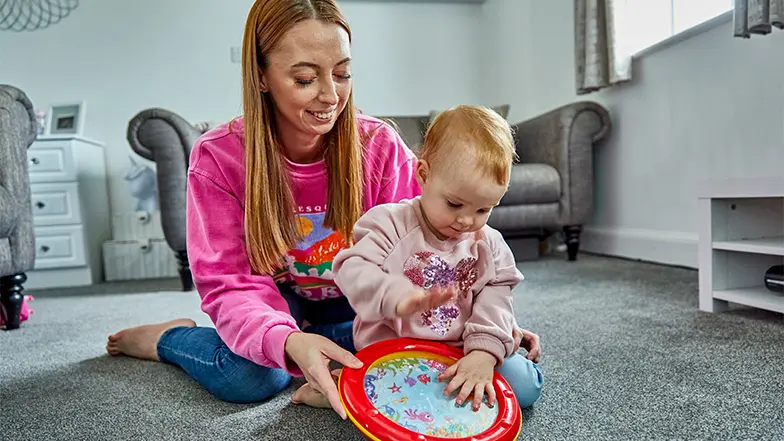
Guide Dogs My Time to Play programme helps children with a visual impairment develop a range of skills to improve their mobility and encourage independence.