1. Find the right makeup products for you
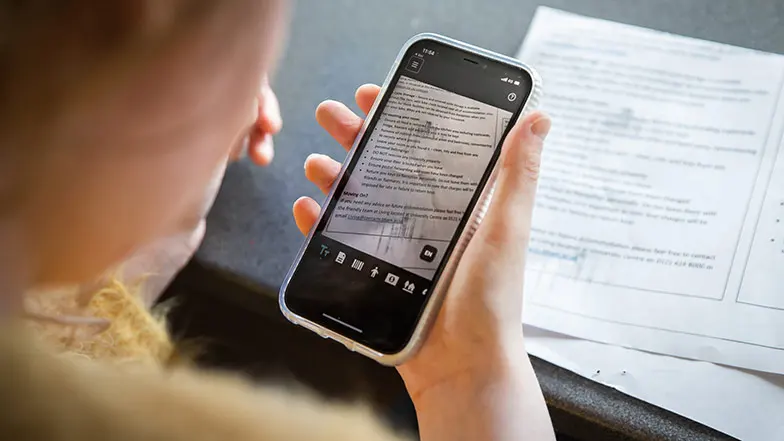
Finding the right makeup brand, product, and colour is always a good place to start. If you’re new to the world of makeup, then visiting a large department store with a sighted friend or family member (or asking the store for an assistant ahead of time, if available) is a good first step. These shops often have lots of makeup counters on the same floor, so you can quickly get an idea of the brands you like.
A beauty expert is often behind each counter, and they can help you pick the right products for your skin type and tone. Just keep in mind that the beauty experts are unlikely to have had any formal sight loss training. Alternatively, there are a couple of apps that can help you to identify the colour of a product. For example, Seeing AI has a colour identifying function, or you could draw on the opinions of volunteers through the Be My Eyes app.
It might sound counterintuitive, but finding the right makeup isn’t always about how it looks. How it feels on your skin, its texture, and ease of application are also important factors. So, experiment and have fun trying different products!
2. Locating your makeup products
After you’ve bought some products you love, you’ll need to find an identification system that works for you. A method to distinguish one product from another is to use tactile markers. For instance, you could tie an elastic band around your foundation, put a 3D sticker on your blusher, and remember that your lipstick packaging is ridged. However, if you have many shades of the same product, you could also distinguish them with Braille labels. Another good way to identify different products is through the read-aloud functions on apps such as Google Lens or Be My Eyes.
Additionally, you could group each product together and have a ‘face pot’ and a ‘lip pot’, for example. These pots could be placed in the order that you use them, or alphabetically – you can try different systems to find out what works best for you.

3. Find a comfortable spot to do your makeup
First, make sure your space is comfortable – applying and playing with makeup should be an enjoyable experience. If your vision impairment means that you have some functional vision, try to ensure the place you do your makeup has an eye-level mirror and plenty of natural light. There are powerful magnifying mirrors which can be useful when you need to be more precise, like when applying eyeliner.
If possible, we recommend you use a private space. This is so you can set your products up in a way that suits you and you can leave them there, and so no one will rush you. Lastly, we recommend that you put your makeup on a surface that can be wiped clean.
4. Preparation steps before applying makeup
Before you apply any makeup, we recommend following these tips to help with hygiene and to improve accuracy.
- Use a headband or hair clips so your hair is out of the way.
- Protect your clothes by wearing a dressing gown or light robe to catch any spillages or loose powder.
- Keep a damp cloth or wet wipes at your makeup station – these are good for wiping your fingertips between products to get rid of the residue.
- If you’re new to makeup, familiarise yourself with the contours of your face using your fingertips and practise new techniques with your fingers or brush without makeup to get used to the action.
5. Discover your makeup routine
Experiment to discover the order in which you prefer to apply your makeup products. Once you’ve found a routine you love, you can store all your products in the order you use them. This will make it easier to track where you are in your makeup routine.
A lot of people prefer to start with face products – such as foundation, concealer, and blusher – so that they have a good base, then build up to eye products and lip products
6. Application tips
We’ve put together some handy makeup application tips to help you become a cosmetic whiz!
For foundation, we recommend you blend using light, circular motions in a small area, then create larger circles, then move to the outer area of your face. It’s always best to overlap the circles as you go to ensure a blended, full coverage.
To be really sure your foundation is blended well, you can use a slightly damp sponge and apply to the outer areas of the face where foundation typically collects, like the jawline, around the ears, and hairline. It’s important that the sponge is only slightly damp, though. You can check the sponge using the back of your hand so as not to impact any makeup you’ve already applied.
Eyeshadow is a really fun product to play with. To ensure no powder falls onto your face below your eyes, you could hold your palm to the outer corner of your eye as a barrier. You can also try an eyeshadow stencil, which can be gel patches or re-usable tools. This provides a guideline if you’d like to try a slightly winged look too.
Use your finger instead of a makeup brush to apply the eye shadow and only place the colour where you can feel your eye underneath.
Mascara can be perceived to be one of the trickiest makeup products to apply if you’re a person with a visual impairment. However, a handy tip is to practise with clear mascara, so if you make a mistake, no one will know! When you feel more confident in your technique, get a darker mascara if that’s the look you’re going for.
When applying mascara, place your hand holding the wand against your cheek to keep the hand steadier and find your lash line more easily. Place the mascara wand at your lash roots and slowly pull it away as you close and open your eye to avoid letting it touch the area around your eye.
You could also experiment with eyelash curlers. Open the curler and hold it up to your eye. Place your lashes between the clamps of the curler, aiming to get close to the base of your lashes (without pinching your eyelid!) Close the clamp and hold for about 5 seconds.
Or for something longer lasting, treat yourself to a lash lift at a salon, which curls and tints your eyelashes and lasts about 3 weeks.
Much like mascara, you can start off with a subtle lip colour until you feel more confident, then experiment with bolder and brighter colours. Using kitchen paper to blot your lipstick will ensure you don’t have any excess product on your lips, and this means the colour is less likely to transfer to places you don’t want it. Finally, you can swill your mouth with water to ensure you don’t accidently have lipstick on your teeth.
7. Check your makeup
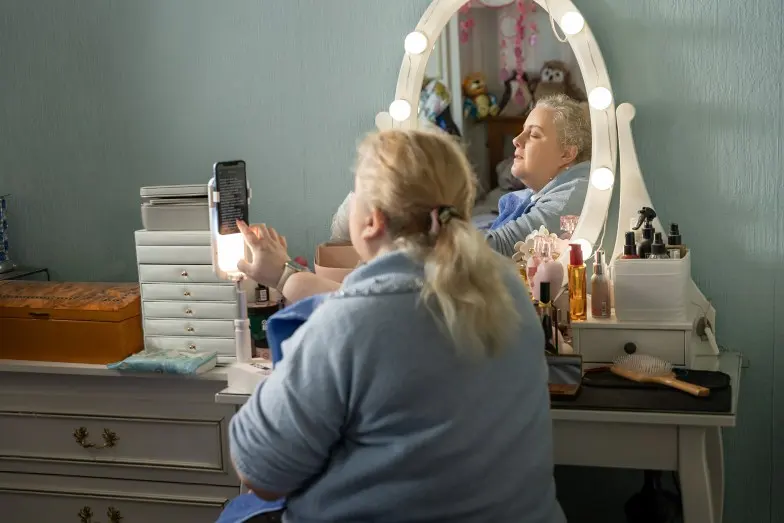
After you’ve finished your makeup, you might want to check it, especially if you’re not used to using cosmetics. If there’s a sighted person you trust nearby, you could ask them. Alternatively, you could ask a friend, family member, or volunteer through the Be My Eyes app. You can also try the AI function within the Be My Eyes app, or Estee Lauder’s Voice-enabled Makeup Assistant app which gives you feedback on your foundation, eyeshadow, and lipstick.
If you wear glasses, we recommend sanitising them at this stage to help avoid blemishes. Also, be sure to wipe your hands and glasses to get rid of any powder and smudge marks.
Tips for removing your makeup
It’s so easy to forget about removing your makeup, especially when you’re tired, but always do it before you go to bed. Makeup like mascara can easily get into your eyes if left on overnight. This has the potential to clog up your tear ducts and irritate your cornea, and this raises the risk of an eye infection.
Tips for removing makeup safely and effectively:
- Start by washing your hands and removing your contact lenses if you wear them.
- Choose a mild cleansing product, preferably free from oil and parabens.
- Use a product designed for the eyes, or Vaseline and baby shampoo are gentle alternatives.
- Avoid harsh ingredients and exfoliators.
- Use cotton wool pads, or clean reusable makeup removal cloths.
- Create a system whereby you start in the middle of your face and work outwards, or move from one side of your face to the other – whichever works best for you.
- Don’t forget about areas on the outside of your face, like your hairline and jaw.
- Wipe your eyes gently, as the skin on your eyes is thinner than the rest of your face.
- Close your eyes and use gentle, circular motions when removing eye makeup, starting from inner corner to outer eye. Then open your eye and run your makeup remover pad from the inner corner to outer corner.
- Wipe all along the base of your eyelashes to remove eyeliner fully.
- Try to avoid getting makeup remover in your eyes and rinse off the product afterwards.