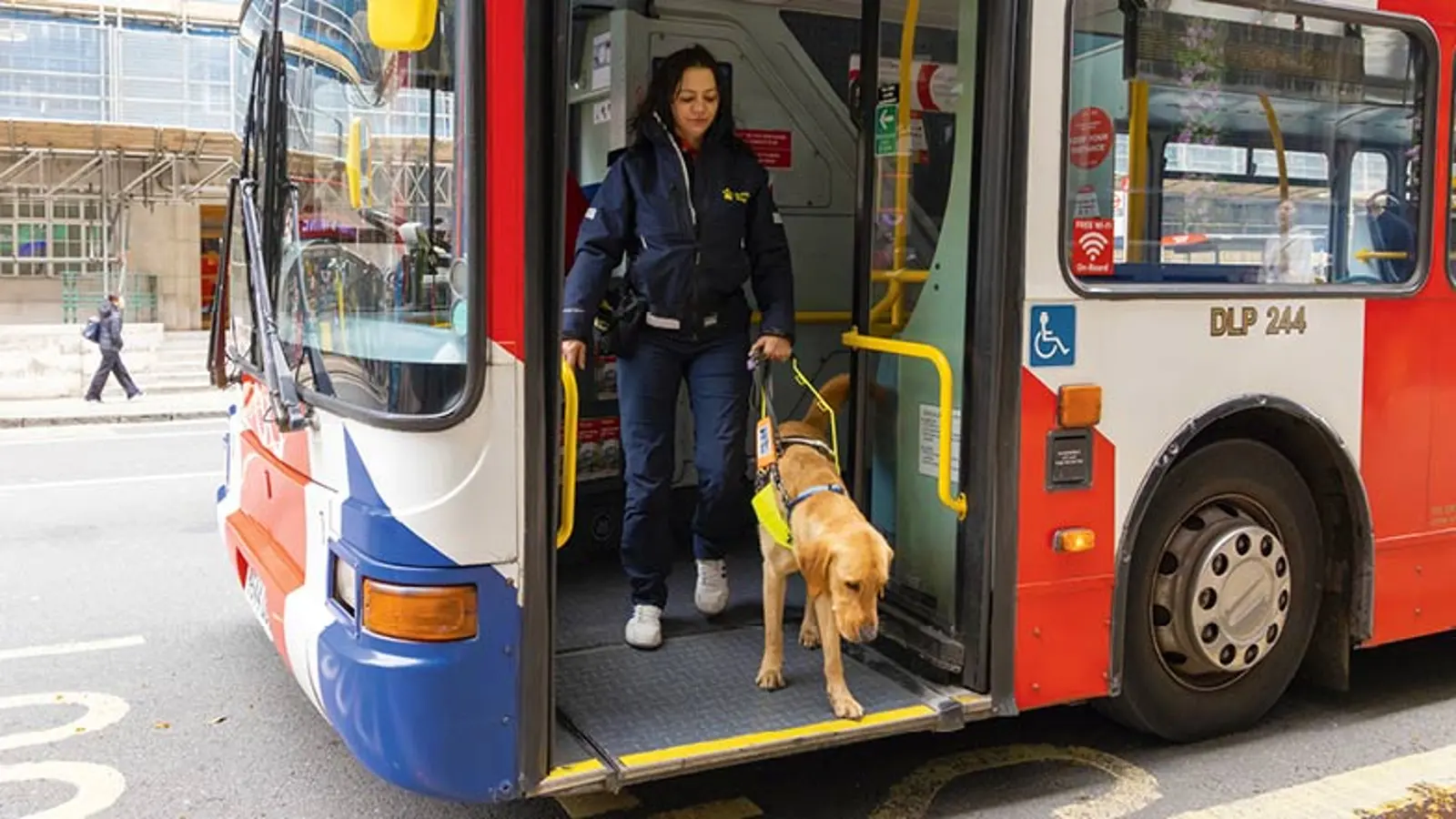
Considerations when bringing your guide dog on a bus or coach
This guide is here to help owners of guide and assistance dogs travel comfortably by coach. It outlines the key steps to make your journey as smooth and stress-free as possible when travelling with your dog.
Please keep in mind that this information is intended as a general guide. For detailed advice or answers to specific questions, it’s always best to contact your coach operator, the travel agent you booked with, or the rail or ferry provider your coach company may use for cross-channel travel. We also recommend taking a moment to read through the welfare considerations page so you can feel fully prepared before your trip.
Accommodation for your guide dog
Firstly, you should find out from the coach operator what accommodation will be available for your dog on the coach they are planning to use for the trip. Coaches come in many configurations, and seating and floor space can vary greatly between vehicles.
Ideally, you are looking to get the coach operator to reserve floor space in the seat next to you or provide space for your dog in an allocated floor area. This must not be in the gangway or where the dog may block other emergency exits. For the comfort of your dog, you may also want to take a suitable bed.
Preparing for emergency stops
It is advisable to tether your dog to a seat belt or seat stanchion using a car harness, which can be obtained from pet shops, online or at many veterinary practices. This is to ensure, that in the case of an emergency stop, your dog does not slide down the gangway or fall down steps by doorways. Dogs must not be tethered by their collar under any circumstances.
Taking rest breaks
It is important that your dog has regular rest breaks, ideally every two to three hours. This should be done to allow your dog to stretch its legs, relieve itself and have a drink or meal if appropriate. Please check with your coach operator that the proposed itinerary has breaks factored into it.
You should also consider where the coach may stop on a journey, as some coach parks, terminals and ports may not be suitable for independent mobility with your dog. This may also mean that there is no grass for dogs who need grass relief, or the movement of other vehicles may make mobility with and relieving your dog hazardous.
European Pets Travel Scheme (PETS)
As with other modes of international travel, your dog will have to comply with the European Pets Travel Scheme (PETS) if crossing the channel.
You will need to ensure you know when checks will be carried out on your journey, as well as where you can get the prescribed Tape Worm treatment for your dog prior to your return to the UK. The PETS travel page on this website has guidance and contact information and what you need to do to comply with it.
If you do need assistance on your journey, you are advised to establish with the coach operator what you can reasonably expect to get in terms of support from the driver or other on–board staff. Also, what support you may get when changing between vehicles at coach stations or at ports.
If you are likely to pick up a European coach service if travelling in mainland Europe, it is advisable to find out what support and advice is available from the company undertaking the European leg of your journey. You won’t necessarily receive the same level of support or assistance in some European countries as is offered in the UK.
_and_Archie_009.jpg?format=webp&width=3840&quality=75)