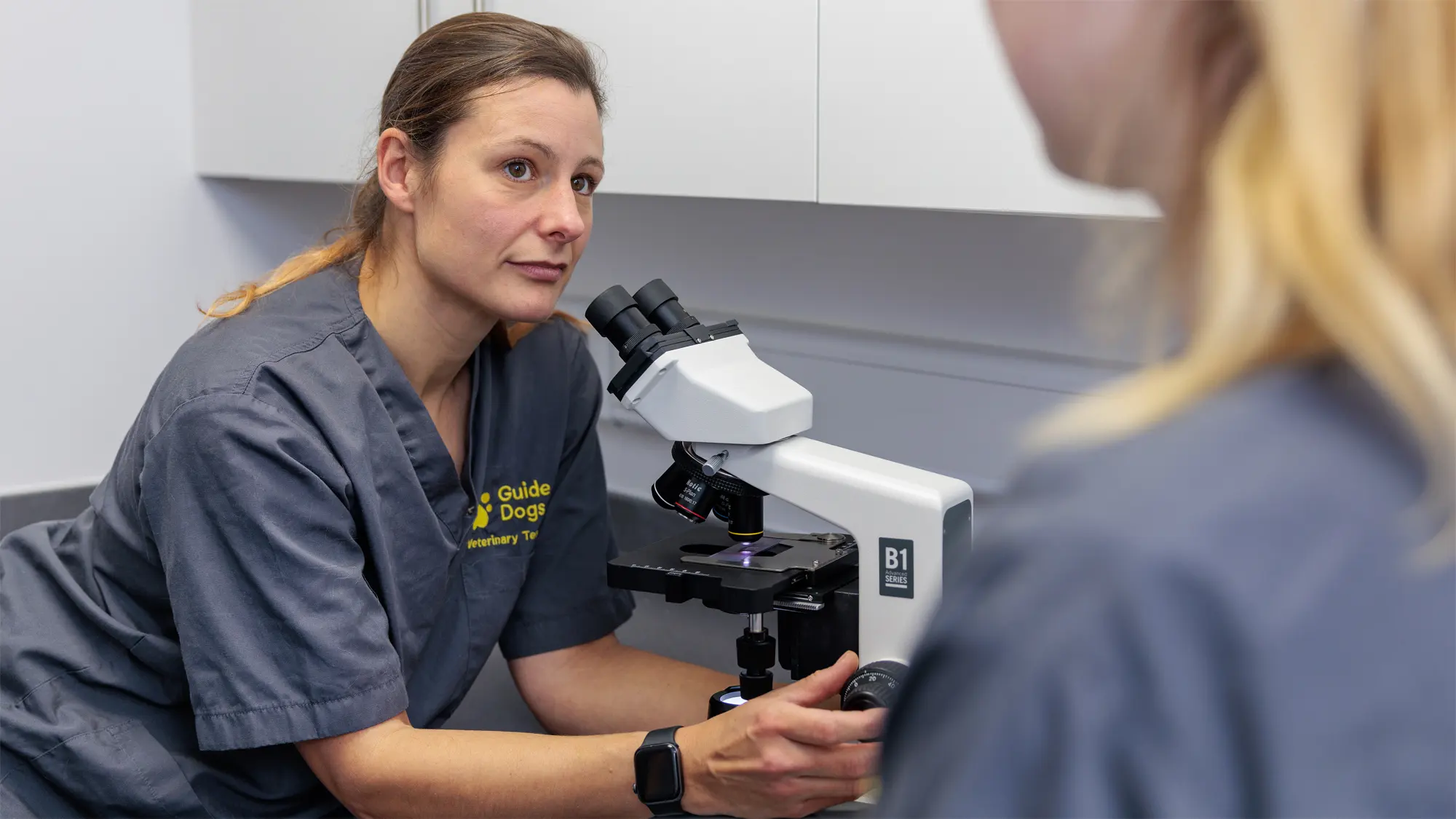
The canine science team undertakes robust, valid and ethical research into dog health, behaviour, wellbeing and reproduction. The team provide insightful, timely and actionable research outputs which enable Guide Dogs to partner happy, healthy dogs with people with vision impairment in the most efficient, effective and forward-thinking way, maximising dog wellbeing, helping Guide Dogs be the best they can be and supporting Guide Dogs’ strategy.
Supporting the gastrointestinal health of our puppies is a key focus of research at Guide Dogs. We recognise that the health of our puppies in their early life plays a critical role in shaping their long-term outcomes, and the establishment and development of a healthy gut microbiome provides a crucial foundation for their overall wellbeing.
The overarching aim of our research is to understand how best to support this microbiome development to ensure our puppies grow into strong and resilient adult dogs. By optimising gastrointestinal health from an early age, we are giving our puppies the best possible start in life and setting them up for success in their future roles.
We are currently running several projects to better understand and improve our puppies’ gastrointestinal health. These include investigating the optimal timing of vaccination, as well as evaluating the effectiveness of a synbiotic supplement in supporting gut health. Alongside the behavioural data we routinely collect, we also monitor the daily faecal scores of our litters throughout their stay at the National Centre, as they transition into puppy raising. This ongoing monitoring allows us to identify trends over time and build a clearer picture of the factors that influence gastrointestinal health.
Decision-making regarding the most appropriate time to neuter a dog is made difficult due to a lack of published information and a lack of clarity in the available veterinary literature. For females, there has been debate as to whether to neuter before or after puberty, and for males and females, there remains contradictory information about the best age to neuter. Researchers at Guide Dogs have completed several studies examining neutering in order to make the best possible decisions for our dogs. These include:
You can read more about our work on neutering in the following journal articles:
Effect of neutering timing in relation to puberty on health in the female dog–a scoping review
Effect of neutering timing in relation to puberty on female dog behaviour
Early socialisation and habituation are very important for a puppy’s wellbeing to provide them with the ability to develop skills, to learn how to cope with new experiences in a positive way and to support them as they grow and mature into adult dogs.
A previous study undertaken by the Guide Dogs research team presented the first evidence-based programme to help puppies aged 0-6 weeks to become familiar with the world around them in a positive way, tailoring socialisation to the puppy’s development. The findings from this study proved that specific interactions in this crucial development phase improved confidence and reduced behaviours associated with anxiety and stress in adult dogs, which is vital for working guide dogs. The recent literature review confirmed that this guidance is still up to date with the latest scientific knowledge in the area.
This short video from 2021 explains the puppy socialisation programme further.
Atopic dermatitis, or atopy, is a common disorder among the breeds used by Guide Dogs. The disease is characterised by an overactive immune response to irritants or allergens (such as dust mites) and typically presents as a persistent itch, the scratching of which may lead to hair loss and redness. Although guide dogs experience a lower prevalence of atopy than many other populations, the costs of diagnosing and treating the condition are significant, as well as having an impact on the welfare of affected dogs, clients, and volunteers.
Guide Dogs undertook a study using genomic data on 347 dogs to determine a moderate to large estimate of heritability, implying substantial genetic variation in susceptibility to atopy, in our population. This means that selection for a reduction in the prevalence and severity of atopy would be successful, and that using genomic data would improve the accuracy, and so rate of response, of this selection. Lowering the genetic predisposition via selection is a means to general and widespread improvement, as opposed to individually targeted therapeutics.
Deterioration in traits related to male fertility has been reported in multiple species, including humans, and has been linked to exposure to environmental chemicals. Since dogs share our environment, they are a useful sentinel species for humans, but Guide Dogs also has an acute interest in maintaining fertility in our breeding population to ensure it is sustainable. Data on both semen traits (% living and % motile sperm) from 2006-2023 and cryptorchidism in male puppies born 1995-2023 were analysed to explore trends and influences.
The semen traits were determined as moderately repeatable for individuals in both golden and Labrador retrievers, implying some influence of environment at specific timepoints but some underlying consistency for individuals. However, there were differences between the two breeds in some aspects; heritability was only detectable in golden retrievers and, while semen traits were found to be declining by about 5% per decade in golden retrievers, % living sperm was actually increasing in Labrador retrievers.
Analysis of cryptorchidism also revealed breed differences, in both prevalence (being higher in golden than Labrador retrievers) and temporal trend (increasing in Labradors while consistent in golden retrievers). The differences across breeds imply the presence of genetic by environment interactions, whereby different breed genetics results in a different trait outcome to the same environmental factors. In addition, reduced prevalence of cryptorchidism in first generation cross individuals provided empirical evidence of hybrid vigour.
Understanding how behaviour is influenced by breeding and the environment is important for us to understand in our puppies, with an aim for Guide Dogs to breed the most behaviourally suitable dogs for the guiding role. A long-term project into the heritability of behaviour using a range of behaviour measures has recently been completed. The project utilised practical assessment data and questionnaire data to explore the genetic influences on behaviour using an extensive pedigree. This short video explains the cognition assessments for puppies, which formed the practical data in this project for puppies around 7-8 weeks of age when at the National Centre. The questionnaire data came from using a refined version of the Puppy Behaviour Questionnaire completed at five, eight and 12 months of age. This academic paper outlines the development of the questionnaire and compares this to the well-known behavioural questionnaire C-BARQ (Canine Behavioral Assessment & Research Questionnaire).
The project also undertook a pilot analysis using genomic data from DNA swabs and provided some interesting results to support the wider genomics project (Born to Guide). Findings from the project indicated correlations between the questionnaire and practical data and how specific behaviours can be influenced through breeding. The environment and the raising of the puppy during their first year of life also have such a large influence on the expression of the behaviour, and supporting both the puppy and puppy raiser through the puppy’s first year of life is fundamental for future behaviours. Findings from this research will support the Breeding Programme with behavioural decision making by enabling the use of Estimated Breeding Values for behaviour.
Information on the outputs from our research into canine science