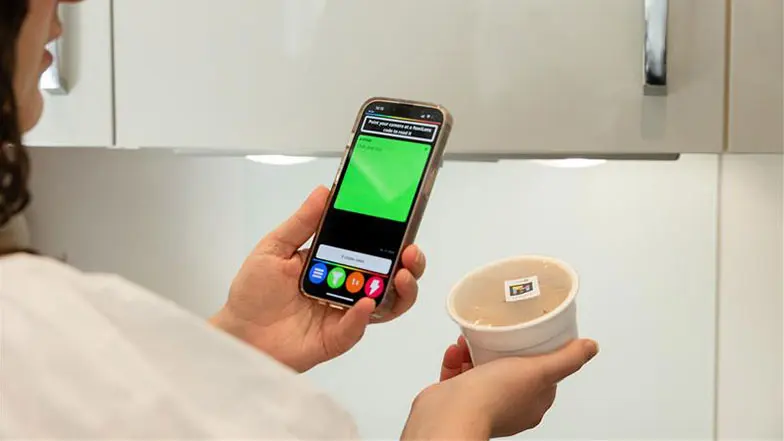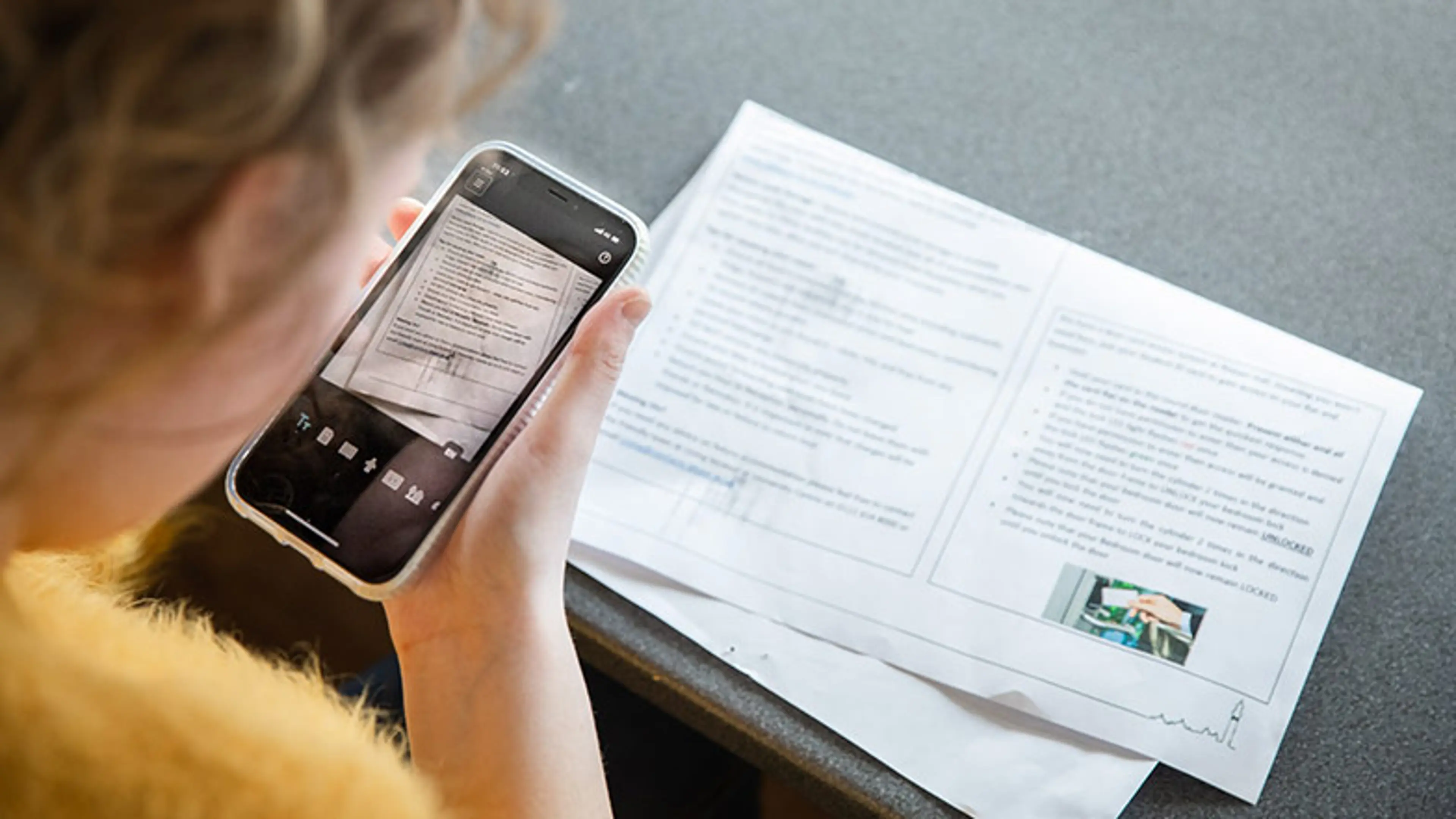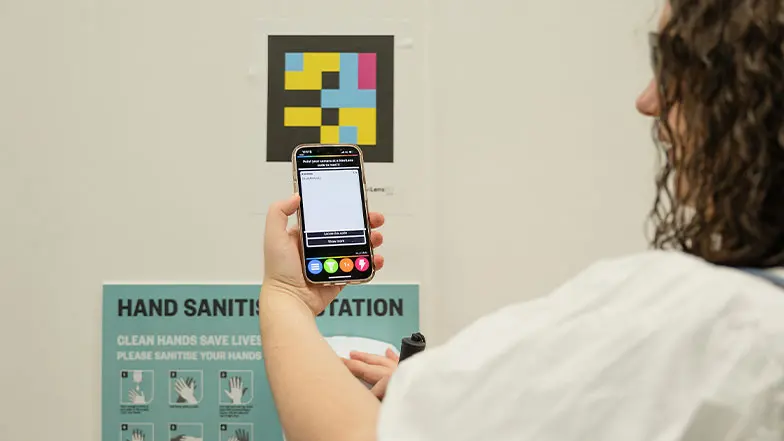
NaviLens is an app that uses colourful, scannable codes to help people who are visually impaired navigate unfamiliar environments, or to give them more information about their surroundings. These codes are called NaviLens codes – they look like brightly coloured QR codes. You can search for and scan NaviLens codes through the NaviLens app.
NaviLens is available on Android and Apple devices and is free to download.

NaviLens codes are scanned, using your phone camera, via the NaviLens app. Once scanned, the code can tell you information about a product, place, or provide directions. NaviLens is unique in several ways. For example:
NaviLens has a few different functions designed to help you find the code you’re looking for and to navigate to that code, if that’s your goal.
With the app open and holding the phone close to your chest, move your body to scan your surrounding area. Your phone will vibrate and make a click sound when the app detects a code. Your phone will make different sounds depending on where you are in relation to the code.
If you’re approaching the code, your phone will emit a series of bleeps that’ll become faster the closer you get to it. Your phone will also tell you the distance between you and the code.
Type, or use speech-to-text, to enter the object or location you’re trying to find in the search bar, and the app will prioritise finding those codes. For example, when you’re looking for the train station, you can type ‘train station’ and the app will search for the related code.
This function means that, even if the camera can no longer see the code you’ve captured, the app will guide you back to that code using audio instructions.
You can request codes to use at home free of charge through the app. Once you enter your email address, you’ll be sent codes that you can print and use where you like.
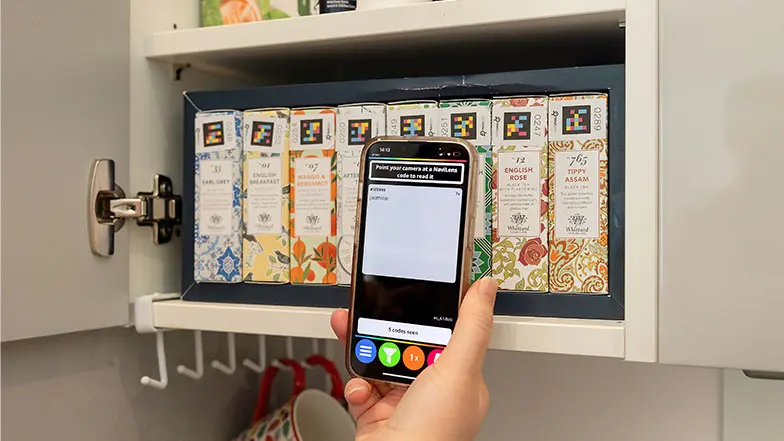
NaviLens can support your independence and day-to-day life in several ways. For example, the codes are useful for:

In the UK, you might find NaviLens codes on some products in supermarkets, at museums and cultural attractions, and in some public transport hubs such as Belfast Grand Central Station and Wolverhampton Bus Station. Read our latest blog on how the use of NaviLens codes at Belfast Grand Central Station makes travel more accessible for people with a vision impairment.
NaviLens GO offers interactive navigation and multimedia experiences triggered by NaviLens tags. This app is designed for visual navigation and is augmented-reality (AR) based, whereas NaviLens is more audio based. For example - in a museum, NaviLens GO guides the visitor using AR arrows. As they move, videos or audio content linked to each tag enhance the experience.
Both apps work with the same NaviLens codes, so it may be worth trying both to work out which is best for you. However, NaviLens is optimised for vision-impaired users, so you may find this more suited to your needs.
You can download NaviLens for free from your device’s app store – for iPhone users this is called the App Store, for Android users this is the Google Play Store. The app’s icon has a white background and features a cartoon eyeball taking a step forward, and there’s a rainbow outline around the cartoon.

If you need more information on audio or tactile labels have a look at our 'Tactile labels and markers page'.

Clew is a free iOS app that helps people with vision impairment navigate indoor spaces using voice and haptic feedback. It lets users record a path and safely retrace their steps.

Google Lens is a free image search app for Android phones and tablets. Learn how you could use it to help identify text and objects and search using photos.

Seeing AI is a free app for Apple iOS devices that uses artificial intelligence (AI) to describe the world around you, including nearby people, text, and objects, and it also scans barcodes.
Looking for recommendations on products and apps that can help you with your daily activities?
Guide Dogs is committed to integrating technology into our service delivery and promoting excellence in accessibility and usability. Our staff undergo comprehensive training in technology and accessibility in collaboration with industry leaders like Apple. We foster knowledge of technology and create content through our Technology Champions, comprising Vision Rehabilitation Specialists and Habilitation Specialists. We review this content periodically to ensure that it is up to date and includes new features and changes with operating systems. We work with our partners to ensure accessibility is at the centre of the design. To find out more, there is more information in our accessibility policy.
Whilst Guide Dogs may be able to suggest various third-party websites and third-party applications which may be able to assist you, those are not endorsed by Guide Dogs. Guide Dogs have no control over those third parties and cannot be held responsible for the accuracy of information and support they can provide or the suitability and quality of any products or services they provide.