We share some useful tips to help you feel confident handling and identifying money.
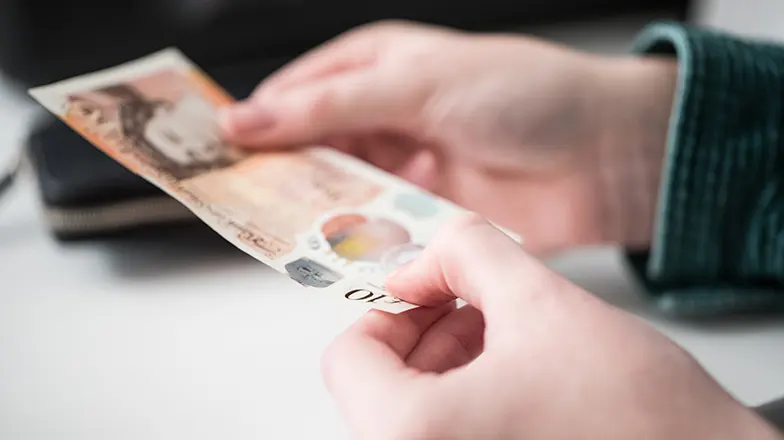
We share some useful tips to help you feel confident handling and identifying money.
One of the best ways of making it easier to identify money is to have an organised system for storing it.
For example:
To practise identifying coins through touch, you might want to place your coins onto a tray that has a lip, so you don’t lose any.
Initially, you may need to practise using two hands to identify each coin. Place the flat of the coin between the thumb and index finger of one hand to gauge its shape and size. Use the index finger of your other hand to draw around the edge of the coin to confirm whether it has a grooved edge. Once you're more confident, you’ll soon be able to do this using one hand.
Begin by pairing the coins…
I can only easily feel the £1 and 50p coins but I leave all the rest at home in a ‘savings’ tin.
Thin, flexible plastic (polymer) banknotes have the same features as the paper notes. They increase in size with their value, include bold numerals and have similar colour palettes to the paper notes. The £10 and £20 notes also have a tactile feature created by a series of raised dots to help you recognise them:
I keep £20 notes and £10 notes in separate places in my purse and fold the £5 notes in half for quick identification.
One way to help you identify a particular bank card is to cut a small indent in the side of it. This doesn’t stop it from working but makes it easy to feel the difference between it and another card. If it’s not a card that you use in an ATM, you could add a tactile bump-on where it’s not going to get in the way.
Loading video...
Some banks provide specially adapted debit and credit cards, free of charge. For example, NatWest and RBS offer cards that include large print, a small notch or tactile logo to identify the correct way to insert the card, and raised dots to identify whether the card is a credit, debit or savings card. At Barclays you can get your card personalised, for example using a colour that makes it easier to identify or putting a large icon such as an arrow on it to show which way to put it into a chip and pin or ATM.
Contact your bank for more information.
Many ATMs have audio or ‘talking’ services and there’s often a headphone jack under the card slot. You can use the ‘Link ATM Locator’ to check if there are any audio ATMs near to you.
ATMs also normally have a raised dot on the number five, which can help you find your way around the keypad.
We recommend you speak directly to someone at your bank’s local branch and arrange some time with a member of staff, who can teach you the layout of the ATM, where to find the earphone slot and the procedures to follow when completing an audio transaction.
If you’re concerned about using an ATM outside, there’s often an ATM you can use inside the branch, or seek assistance from a member of staff.
Loading video...
Using contactless payments is quick and easy, and quicker than handling notes and coins, although there are limits on how much money you can charge. Use the tips above to identify the correct card and which end of the card to use. Another option if you have one, is to use your iPhone, Apple Watch or another smart device to make contactless payments. It takes a little setting up but again works well.