The main types of scotoma
Your central vision is damaged but not blocked completely. It means you can still see things, although not clearly, as your vision is misty or hazy.
There are some strategies you can use called eccentric viewing and the steady eye strategy. You may not need these, but they could be helpful depending on what task you’re trying to do. You’ll probably benefit from specific lighting (known as task lighting) to help with what you’re doing, as well as using larger print size and/or magnification aids.
If you find it’s challenging to read larger text or use a magnifier for long periods of time, try listening to audio books, newspapers and magazines instead.
Your central vision is completely lost. You might find some strategies called eccentric viewing and the steady eye strategy helpful.
Your central vision loss appears as a ring, with some healthy vision in the very centre, then a ring of damaged vision and healthy outer (peripheral) vision.
If you have a ring scotoma but the very centre of the retina is healthy, you might find a strategy called the steady eye strategy helpful. You may also find reading a smaller print size easier as you can fit it into the area of healthy vision at the centre of the ring.
You have areas of damaged vision scattered across the centre with healthy vision in between. Depending on what areas of the retina are damaged, you might find using magnification helpful. It’s also worth considering using strategies called eccentric viewing and the steady eye strategy.
You normally only notice this form of central vision damage when looking at straight lines such as blinds, fences or lamppost, as they appear wavy or distorted. You might find some strategies called eccentric viewing and the steady eye strategy helpful.
Skills and strategies
If you have central vision damage, there are some really useful strategies and tools you can use to make everyday activities easier.
Low vision aids
There are a range of low vision aids available, which primarily involve different strengths of magnifier and monoculars. For more information, take a look at our advice on viewing or reading nearby objects and viewing things in the distance.
Lighting
It’s important you find the lighting that best suits your needs in each area of your home, depending on what you’re doing there. For example, you may need bright strip lights in the kitchen to illuminate the countertops or a specific task light for things like writing or reading. Take a look at our lighting guide for more detailed advice and information.
Writing and reading aids
You can ask for letters and bills to be sent to you in large print to make reading easier.
A strong contrast between the print colour and the colour of the background – bold black letters on white paper for example – can also help.
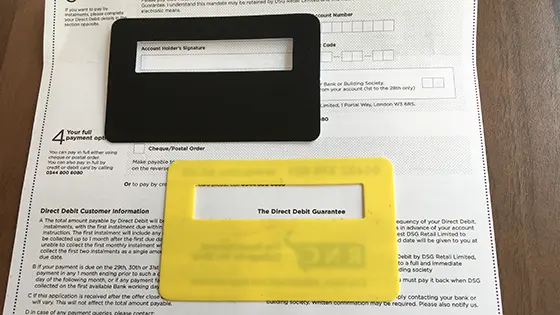
In terms of writing, try using thick lined paper and a thicker marker pen. There are also some pieces of equipment that can help with your writing, including rigid or flexible handwriting guides and signature guides.
Audio devices
There’s a huge range of home devices that come with audio features nowadays. Some examples include talking clocks, talking scales and audio books. Smart home virtual assistants are activated by speech and can be set up to link to a number of other smart features in your home. For example, you can use the virtual assistant to control your smart lightbulbs, central heating, music and diary appointments, read out recipes, set timers or reminders, etc.
Eccentric viewing
The eccentric viewing strategy is a way of learning to use your peripheral vision more effectively. It can be useful if you have central vision loss (i.e. if you have difficulty seeing things when you look directly at them) and can help with reading and seeing detail.
‘Eccentric’ simply means ‘off centre’ and eccentric viewing involves learning to change your point of focus away from the area of damaged central vision onto an area of the retina that works better. This can take practice and you might find it helpful to ask a trained specialist for some support. Eccentric viewing uses a single eye technique — it’s not something you can do with both eyes.
If eccentric viewing is new to you, and you don’t have the help of a trained specialist, it can be challenging to identify which point of fixation (the point of focus) is the most effective. We’ve got some exercises you can try to explore which area of your retina is least affected and in which direction you should move your gaze to view things more effectively.
You may have already started doing this automatically and have found a preferred way of seeing things more easily. If so, you’re using what’s known in low vision services as a ‘Preferred Retinal Locus’ (PRL). The area you have opted to use may be the best and healthiest area of the retina to use or you may find there’s a better area. That alternative area is known as the ‘Trained Retinal Locus’(TRL).
If the most intact part of your retina is closest to the macula (the centre of the retina), you may find this too difficult to use or not practical. If so, you should use an area that is more comfortable.
Cardinal direction method
This method is based on using the four main points of the compass – north, south, east and west.
Stand in front of a mirror or hold a mirror, then close the eye with the worst vision, look straight at your reflection and see which parts of your face you can see.
If you can’t see your nose, try looking at each of the four main points of the compass in this order:
- Look north (up), towards your forehead, can you see your nose?
- If not, try looking west, towards your left ear, can you see your nose?
- If still not, then look south (down) towards your chin.
- If you still can’t see your nose, look east towards your right ear.
If looking north brought your nose into view, then your best area of vision is at the bottom and to view things more clearly you need to look up. In practical terms, it means that you’ve found a point where, if you use eccentric viewing for reading, you’re keeping the damaged vision away and not blocking the next word or line you need to view. If you use eccentric viewing when moving around outside, the same applies when looking for traffic.
If north doesn’t work, viewing west is the second most effective for reading, as again, you’re not blocking anything you need to see next.
Clock face method
If the cardinal direction method didn’t work, let’s try the clock face method.
First, hold a round clock at arm’s length. Close the eye with the worst vision and look at the centre of the clock. Note how well you can see the numbers around the edge. Which numbers appear the clearest and can you see any parts of the hands?
If:
- one was the clearest, try looking towards seven do the hands appear clear?
- two was the clearest, try looking towards eight, do the hands appear clear?
- four was the clearest, try looking towards 10, do the hands appear clear?
- five was the clearest, try looking towards 11, do the hands appear clear?
- seven was the clearest, try looking towards one, do the hands appear clear?
- eight was the clearest, try looking towards two, do the hands appear clear?
- 10 was the clearest, try looking towards four, do the hands appear clear?
- 11 was the clearest, try looking towards five, do the hands appear clear?
Eccentric viewing in practice
Now try taking this eccentric (off centre) viewing technique to look at things around the home. For example, if you found that looking up (12 o’clock) made your face in the mirror the clearest, try looking slightly above the TV screen.
You can use eccentric viewing with our suggested visual strategies once you’ve found the fixation point that works for you. For example, if your best point of vision is at the bottom, you’ll need to look up slightly before trying the strategies.
You may not need to use eccentric viewing if when you looked in the mirror your nose was clear when looking straight ahead and/or the centre of the clock was clear when looking straight ahead.
The steady eye strategy
The steady eye strategy is a technique that helps specifically with reading. Usually when fully sighted people read, they keep the page still and move their eyes systematically over the words. If you have central vision damage, this process is very difficult, if not impossible.
The steady eye strategy means that you keep your eyes fixed in one position and pass the letters and words in front of your eyes from right to left. Once you get to the end of the line, move the page up and back across to the right and repeat with the next line.
If you use eccentric viewing at the same time, move your view so the best point of vision is in the centre and then move the letters and words through the area of best vision. This skill doesn’t come naturally to most people but it will come with practice.