We’re here to provide the best support for people with sight loss, so we’re passionate about developing the skills and knowledge of our staff. If you’re interested in a career working with our amazing dogs and the people whose lives they change, then you’re in the right place to find out more about our two key technical roles – Guide Dog Trainer (GDT) and Guide Dog Mobility Specialist (GDMS). Both roles involve a full learning programme to ensure you’ll have all the skills you need. We teach those skills through our Guide Dogs Academy.
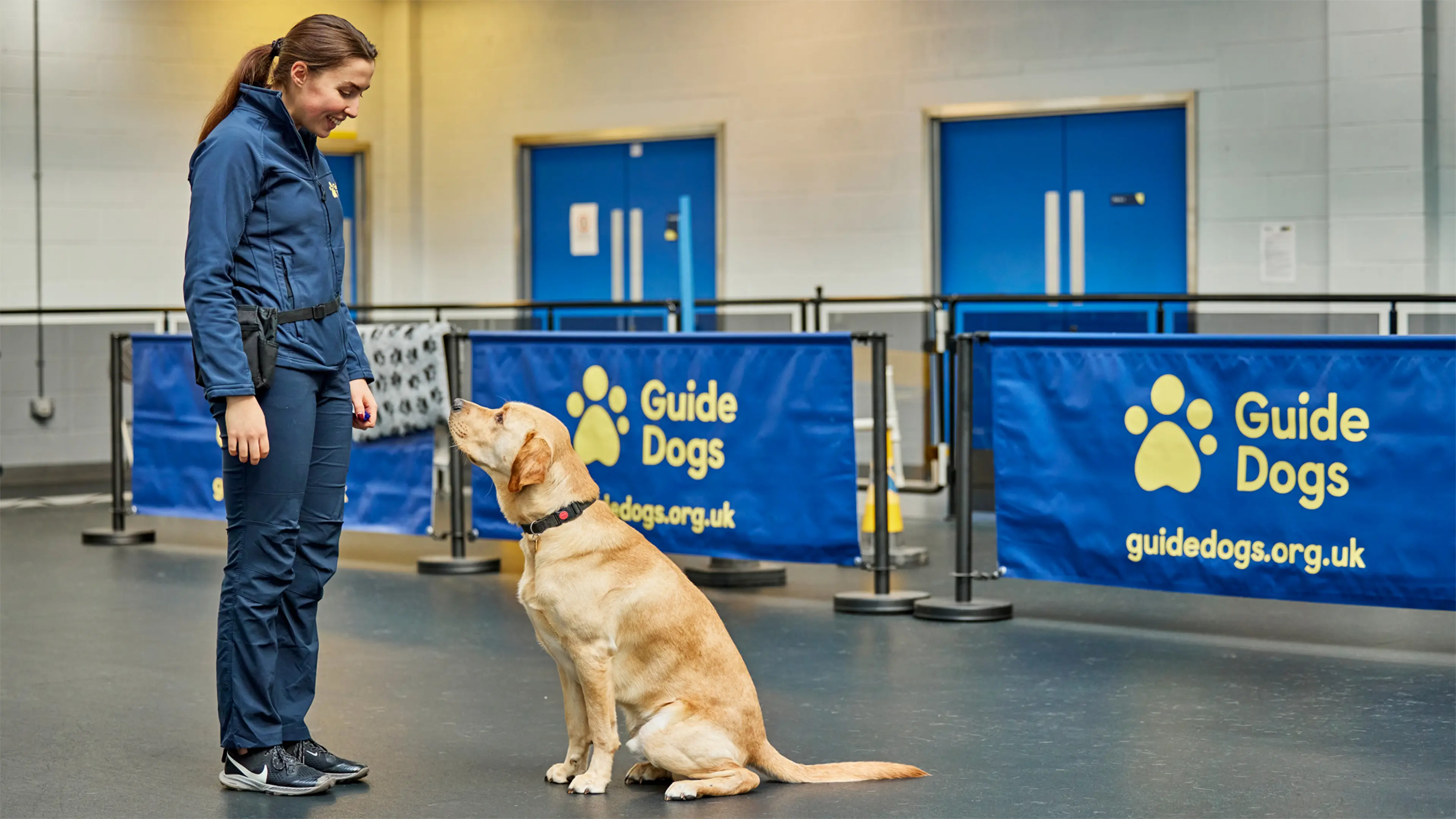
The Academy is how we recruit, train and develop our technical staff (the people training the dogs, our clients, and then the partnership together). It’s not a physical building – instead, our learners are based in local teams all around the country with their own Academy tutor, who teaches one small group at a time, with lots of hands-on experiences from day one.
Currently, the Academy produces our future Guide Dog Trainers (GDTs) and Guide Dog Mobility Specialists (GDMSs).
Guide Dog Trainers take our dogs when they first come into training, using positive reinforcement training to give them the skills, experiences, and confidence for their future as life-changers.
Loading video...
Guide Dog Mobility Specialists match our dogs with their future guide dog owners, working with the dogs and the owners to teach all the important skills to create and maintain successful partnerships. They also provide support to existing partnerships by teaching new routes and helping them adjust as their needs develop and change.
Loading video...
As you’ve found out above, GDTs and GDMSs work closely together, but their roles have very different focuses. Watch our Technical Learning Specialists (the ‘tutors’ within the Academy) discussing their experiences of doing and teaching, the different roles.
Loading video...
Guide Dogs Mobility Specialist or Guide Dog Trainer – which one is right for me?
In Academy, you’ll follow a structured learning plan that builds on your current skills and experience, and you’ll learn new skills through a combination of hands-on practical learning, digital content, workshops, observations and peer, group and self-directed learning.
This means you’ll understand the theory and then be able to put it into practice through hands-on practical work, first with the support of your TLS, and then more independently – and you’ll be based with a local Guide Dogs team, so you’ll benefit from seeing the work all around you.
We take your professional development seriously and you’ll be working with world leaders in dog behaviour and experts in working with people with vision impairment.
Your learning plan will help you:
It's a big change and there’s so much to learn – I wanted that direct contact with people and dogs, and to make a real difference to people’s lives. I’ve been amazed by the level of expertise, the support and how much I’m learning. But it’s awesome – no two days are the same and the dogs are so much fun to work with. You can see them learning along with you!
We don't look for one type of person in Academy. We value the experiences people bring to the role from a wide variety of backgrounds including, but definitely not limited to, teaching, emergency services, nursing, social care, counselling or straight from an educational setting. What unites our learners is the desire to really change lives.
So, here’s what we’re looking for:
Spending time gaining experience in these areas can only benefit your application. Volunteering with us is also a great way to gain more experience with Guide Dogs before Academy positions become available.
We recruit Academy learners into both roles throughout the year across the UK. How many people we take on, the locations and start dates vary from year to year. To apply you need to complete an online application once the roles are advertised.
All Guide Dogs vacancies, including our learner roles, are advertised on our jobs board when they are available. You can also set up job alerts for roles or locations, so you can make sure you hear about any new opportunities as soon as they are available.
If you can’t see a role that suits you sign up for job alerts to be the first to be alerted when a new role becomes available.
Do you want to join our Academy? Discover our latest vacancies
It takes around two and a half years to qualify as an Academy Guide Dog Trainer and around three years as an Academy Guide Dog Mobility Specialist. The exact time varies as we tailor each person’s journey, and you graduate from the Academy when we know you’re ready. It’s an investment from you and Guide Dogs, and once you’re a GDT or a GDMS you’re part of a global community of professionals.
A commitment to learning is vital for this role. You’ll be learning all the time as well as sharing your own experiences with others.
You must be willing to take responsibility for your own learning and proactive in organising your time to ensure all your learning is planned and completed on time. Your Technical Learning Specialist is your line manager and coach, and there to support you every step of the way so a willingness to ask for help when needed is also important.
As an adult learner, you bring maturity and experience to your new role. You also arrive with unique characteristics that affect how you learn. Guide Dogs Academy has designed a learner journey that fits with adult learning theory and supports the ways in which you learn. As part of your role, you’ll be asked to sign a Learner Agreement committing to this learning culture.
As an Academy Guide Dog Trainer (AGDT) your annual starting salary will be from £22,660 to £26,000, depending on your experience. Throughout your training, you'll receive competency-based gradual salary increments. Once you graduate from the Academy (usually within two and a half years of starting training) your salary will increase to £27,025.
As an Academy Guide Dog Mobility Specialist (AGDMS) your annual starting salary will be from £24,519 to £28,000 depending on your experience. Again, you’ll receive competency-based gradual salary increments throughout your training, and once you graduate from the Academy (usually within three years of starting training) your salary will increase to £34,122.
Questions? We love talking about Academy, so if you have any questions at all, you can get in touch with us at recruitment@guidedogs.org.uk.
Both are very active roles! No two days are the same within the Academy, but most days do require a large amount of walking and handling large dogs. On average, our current teams complete around 15,000-20,000 steps per day – whether that’s in our centres, out on training walks with fellow learners, or engaging in active lessons within the training rooms themselves.
As you’ll be handling large dogs, you’ll need to have a suitable level of strength and fitness. It’s important that you let us know at the appropriate time if you have any pre-existing injuries that we need to take into account to ensure we are working safely and we provide the appropriate level of support for you.
Yes, we provide all our Academy staff with appropriate uniform to do their role – in all weathers and for the full working week! This includes a high-quality outdoor coat along with all required dog training equipment. We never ask our staff to contribute towards the cost of their uniform, although you can choose to buy more uniform if you wish to. The only thing you need to provide is suitable footwear.
Guide Dogs covers the cost of your training as an Academy Learner to enable you to qualify as a Guide Dog Trainer or a Guide Dog Mobility Specialist. It's normal for organisations who pay a substantial cost for the training of new staff to operate with a ‘claw back’ policy. This is where staff who decide to leave a role before their training has ended, or within a time period post-graduation, would be asked to repay some or all of their training fees. This is something that we do at Guide Dogs. The policy is in place to protect the investment of charitable funds being made when training new staff.
In both our roles a substantial amount of local and regional travel is required. Although we use public transport as much as possible, there are times when we need to use our own vans and vehicles, so we ask that all our Technical Learning Specialists and learners are able to drive.
Both our roles are based at your local centre and do not include any home-working. You'll be part of a small cohort of learners working through the training cycles together – you’ll need to be hands on and support each other. Your Technical Learning Specialist will be available each day and will be your first port of call for queries and advice as you move through the programme, but your fellow learners will also be around to give you support and encouragement too. You’re often likely to be out and about, working both on and off-site, in order to socialise and train dogs in a variety of settings such as parks, supermarkets, and on public transport.
As part of your role, you'll be driving a van suitable for transporting up to four dogs and up to four people. You don’t need any prior experience of driving vans as we will provide all the training needed to help you feel skilled and confident.
Our sites often cover a wide geographical area so the role does require a substantial amount of driving with journeys not infrequently over an hour in length. There may be times when you are required to stay overnight, and work evenings and weekends as needed.
In order to facilitate the driving element of the AGDMS role you will be allocated a large vehicle suitable for the safe transportation of dogs and people. This is treated as a ‘benefit in kind’ and you will pay tax on it. Car insurance and all regular maintenance of the vehicle is paid for by Guide Dogs.
As a Guide Dog Mobility Specialist there are restrictions regarding when you are able to take annual leave due to the element of working with our service users. Although we will aim to support any personal circumstances, restrictions may also include school holidays. Some restrictive periods normally around client training times when continuity is important, can be for five weeks or more in duration.
As a Guide Dog Trainer your role involves less service user contact so you are less restricted on when you are able to take annual leave.