Video games, board games, and card games usually involve visual elements. On this page, we explore which digital accessibility settings in video and computer games, along with tactile and Braille versions of traditional card and board games, help people who are blind or visually impaired get the most out of gaming.
Video games for people with sight loss
When thinking about accessible games for players with sight loss or visual impairment, it’s important to consider the accessibility settings each game offers, as well as how accessible each console is.
Game settings and accessibility features
Many modern video games have in-built features which make them more accessible for gamers who are blind or partially sighted. Not all accessibility features are specifically for players who have visual impairment, so here’s a list of features you should look for in a game, or adaptions you can make at home to get the most out of your gaming experience.
- Screen narration: this will help you to understand what’s happening on screen. If screen narration isn’t an in-built feature, see if you can connect your own screen reader to read out the menu navigation and game information.
- Menu navigation assistance tools: these will help you to know which options you’re selecting.
- High contrast modes: these make the important elements of the game visually stand out.
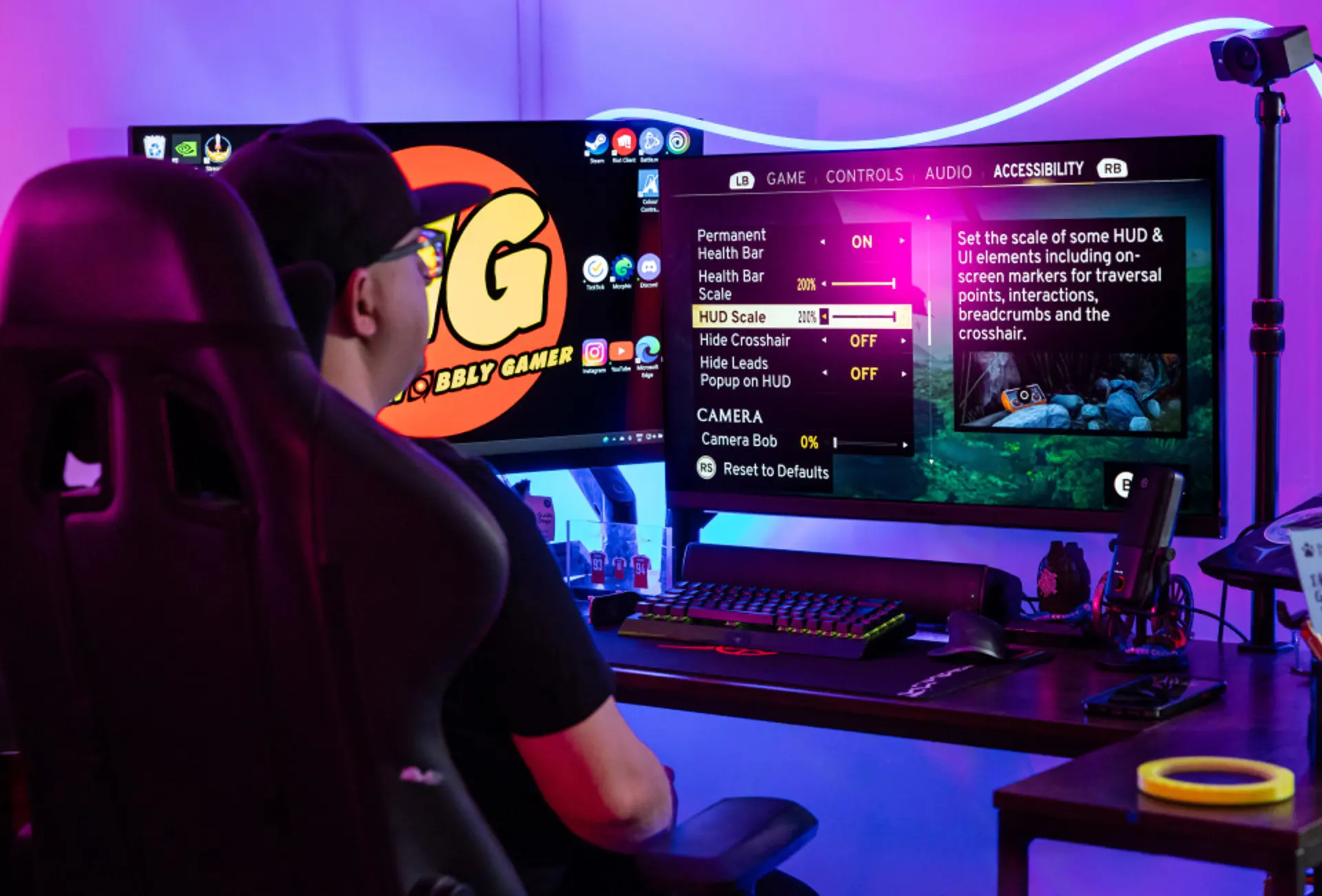
- HUD scaling: this feature allows you to change the size of the user interface to suit your needs.
- HUD colours: this feature can reduce eye strain and helps with target identification – for example, you could make ‘good’ characters blue and ‘bad’ characters red. If this isn’t included, there are programmes you can install that change the colours, but these may come with a security risk.
- Larger fonts or adjustable font sizes: it’s handy to be able to adjust the text in menus, make other players’ names larger, and increase the font size of captions.
- Aim assist or auto aim: this allows your camera and aim to snap to the target – ideal for first-person shooter games.
- Magnification: this will allow you to zoom in on sections of the screen.
- 3D audio: this feature means that the game’s audio is directional; so, if there’s an enemy approaching, the sound will feel like it’s coming from that direction in your 3D space and will increase in volume as they approach.
- Be My Eyes: use Seeing AI or Be My Eyes to identify something in the game.
Accessible video games
Some of the latest and most popular video games include comprehensive accessibility settings for blind or partially sighted players. Some examples include:
- Forza Motorsport
- The Last of Us: Part I and II
- Star Wars Jedi: Survivor
- Pokémon Reborn
- A Blind Legend
- Spider-Man 2
- The Vale: Shadow of the Crown
- God of War Ragnarök
For more information on these games and which accessibility features they offer, visit our accessible games page
Accessible consoles for gamers with sight loss
Buying a console is a commitment. For many, it’s an expensive purchase and only replaced every couple of years, so it’s best to choose the one that’ll give you the best gaming experience possible. One of the first things you’ll have to decide is whether you’d like a hand-held console or one that you connect to another screen.
If you’re thinking about a traditional console that connects to an external screen, like PlayStation 5 or Xbox, some points worth considering are:
- Whether the console itself has accessibility support
- Whether it has an adaptive controller, such as the Xbox Adaptive Controller or the PlayStation 5 Access Controller
- Whether it support speech-to-text and text-to-speech functionalities
- Whether it supports external accessibility tools
- Whether the controller supports button remapping
If you’re considering a hand-held console, like Nintendo Switch 2 or Steam Deck, consider the points of a traditional console in addition to:
- Whether you can create shortcuts on the handset
- Whether the in-built screen is large enough
- Whether it has zoom or magnification options
- Whether the audio quality is good enough for your needs
- Whether you’ll need sighted help to navigate the touchscreen
“I would like to see every major publisher with a dedicated accessibility team that consists of skilled matter experts who have lived experience of gaming with a disability, with the right people in the right roles accessible games are made (and made well).”
Loading video...
Tactile games for people with sight loss
Tactile games allow players with visual impairment to understand which cards they hold in their hands, or to interpret a board game, without visual cues. These games are often designed for both blind and sighted players, meaning they’re ideal for game nights where players have different needs.
Board games
Braille versions of classic board games, as well as games which rely on the players’ imaginations, offer a great way for players with visual impairment to enjoy board games.
- Braille Monopoly: there’s a plastic overlay on top of the traditional Monopoly board that features the property names in Braille. The edge of the board and property boundaries are raised so you can distinguish the geography of the board more easily. The title deed cards, community chest cards, chance cards, and money notes include Braille, and the game includes tactile dice.
- Braille Scrabble: the game includes tiles that feature both Braille and alphabet characters. On the board, the area around each tile space is raised to keep each played letter in place and squares that enable higher scoring have tactile markers.
- Tactile Chess: there’s a small, tactile marker on top of one set of pieces, so you can distinguish your pieces from those of your opponent. Every square on the board has a hole and each piece has a peg, so when a piece occupies a square and the peg is in the hole, it’ll be secure, allowing it to be felt by players without knocking it over. The light and dark squares are distinguished from one another because they sit at different heights.
- Tactile Checkers: each counter has a peg at the bottom and each square has a hole, meaning that when you place a counter on a square it’ll stay there. This is so players can feel where the pieces are before making their move. One set of counters will have a tactile marker, so you can tell which pieces are yours.
- Tactile puzzles: a tactile Rubik’s Cube (which has different shapes on each side) is a great brain teaser, or a tactile Noughts and Crosses board is ideal for a quick game if just two players are involved.
- Story-led board games: story-led board games, such as Dungeons and Dragons, offer an alternative to traditional board games as they rely on players’ creativity and imagination to bring them to life.
Card games
With Braille versions and jumbo card sizes available, there are many options for accessible card games, including many of the classics:
- Braille Uno
- Braille Poker
- Braille Blackjack
- Braille Bingo