Loading video...
Apple Watch features and benefits
Apple Watch is Apple’s smartwatch product. There are three different series of Apple Watch: Apple Watch SE, Apple Watch, and Apple Watch Ultra.
For people with sight loss or vision impairment, an Apple Watch offers lots of features to make daily tasks more convenient. Some of these features include:
- Quickly accessing and responding to notifications without having to search for your phone in your bag.
- Easily paying for things with Apple Pay without having to find your purse or wallet.
- Double tap gestures: these allow you to control your Apple Watch with one hand and without needing to touch the screen – ideal for actions like answering or ending calls and playing or pausing music.
- VoiceOver: the built-in screen reader that will read aloud what’s on your Apple Watch display.
- Taptic Engine: gives you haptic feedback for notifications and navigation, which feels like a light vibration or tap on your wrist.
- Siri: enables hands-free control and access to information.
- Health and fitness tracking: monitor your workouts, sleep, heart rate, and more.
- Navigation assistance: gives you haptic feedback when you need to change direction or take an action while navigating somewhere using Apple Maps.
- Fall Detection: if your Apple Watch senses you’ve had a hard fall, it’ll give you the option to make an emergency call.
- Seamless iPhone integration: extends some iPhone accessibility features for an easier transition between the two devices.
- The ability to control other smart home technology from your Apple Watch, like altering lighting and blinds.
Android smartwatches
Different Android brands have their own smartwatch series, such as Google Pixel Watch and Samsung Galaxy Watch. Although our Habilitation and Vision Rehabilitation Specialists don’t typically use these smartwatches with our service users, they do offer features that could be helpful for people with vision impairment.
Google Pixel Watch features and benefits
Google Pixel Watch is Google’s brand of smartwatch. There’s only one series of Google Pixel Watch with three versions of the device. The Google Pixel Watch shares a lot of the same accessibility features with the Google Pixel phone, such as magnification and TalkBack. However, the Google Pixel Watch has some other features that make it useful for people with sight loss, such as:
- The ability to make contactless payments, so you don’t need to have a card, cash, or your phone at the ready.
- The ability to access QR tickets or passes in your Google Wallet.
- Emergency safety features, such as Fall Detection, Emergency SOS, Emergency Sharing to send your location to others, and the ability for other people to read your medical information when the watch is locked.
- Google Assistant for voice assistance support.
- Fitness and health tracking, including your heartrate and ECG with a FitBit subscription.
- Google Home for Wear OS lets you control your connected home devices and receive camera alerts.
- Turn-by-turn navigation on your watch when using Google Maps which reduces the need to get your phone out.
Samsung Galaxy Watch features and benefits
Samsung have several smartwatch series, including Samsung Galaxy Watch and Samsung Galaxy Watch Ultra. The watches in the different series vary in features and technical specifications, so it’s important to research to make sure you’re getting the right watch for your needs. For people with vision impairment, some handy features of Samsung Galaxy Watches include:
- Display enhancements such as magnification, high contrast fonts, colour inversion, removing animations, bold text, and more.
- TalkBack audio description (the same as on Samsung phones).
- Hearing enhancements such as switching the audio from stereo (when sound appears to be coming from multiple directions) to mono (when sound appears to be coming from one direction).
- Option to add shortcuts for accessibility options.
- You can set up your Samsung Galaxy Watch to vibrate at certain time intervals, such as every hour.
- The ability to answer calls and respond to notifications.
- Fitness and health tracking technology.
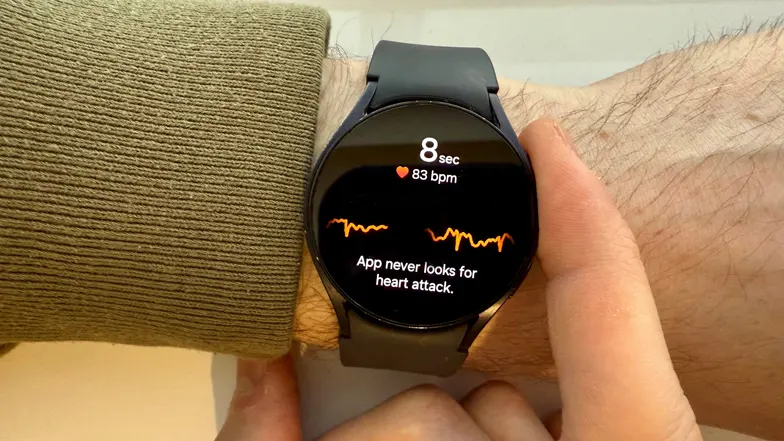
I love the convenience of being able to tell the time discreetly through haptic feedback, make payments without faffing around with my wallet and monitor my daily fitness goals from my wrist.
Things to consider when using a smartwatch
Before you buy and use a smartwatch, here are some things to keep in mind:
- When using any wearable technology, ensure you remain aware of your surroundings.
- Some smartwatch features are only available with WiFi or cellular data.
- Smartwatches tend to work better with a device that’s part of the same brand or device-type. For example, iPhone users will likely get more out of an Apple Watch, whereas people with a Samsung phone will probably get more from a Samsung Galaxy Watch.
Making the most of your smartwatch technology
If you already have an Apple or Android phone, check out our Apple accessibility features page or Android accessibility features page. On these pages you’ll find more information on the accessibility features included with the manufacturers’ operating systems. Remember that not all accessibility features on phones are available on smartwatches, so always double check the manufacturer’s site before buying a smartwatch.
If you’d like some support in using one of these products, speak to your Habilitation Specialist, Vision Rehabilitation Specialist, or call Guide Line on 0800 781 1444 and someone will be happy to assist you.